
Your Kid Doesn’t Know What They Like Yet – And That’s the Point
Most parents approach outdoor activities backward.
They think: “My child likes X, so we’ll do more X.”
Or: “My child doesn’t like being outside, so outdoor activities aren’t for us.”
Here’s what developmental research actually shows: interests aren’t fixed in 4th and 5th grade. They’re forming.
The Exploratory Window
Child development researchers have documented something specific about this age range.
Fourth and fifth graders are in what psychologists call the “exploratory phase.” Their brains are wired to try new things. To test boundaries. To discover what they’re capable of.
This window doesn’t stay open forever.
By middle school, social dynamics shift. Self-consciousness kicks in. The willingness to look awkward while learning something new starts to close.
Fourth and fifth grade is when kids are still curious enough to try and resilient enough to fail without shutting down.
What “Not Outdoorsy” Actually Means
When a parent says their child isn’t outdoorsy, they usually mean one of two things:
Their child hasn’t enjoyed the outdoor activities they’ve tried so far.
Or their child defaults to screens and resists leaving the house.
Neither of these means the child isn’t outdoorsy. It means they haven’t found their thing yet.
A child who hates hiking might love rock climbing. A child who finds nature walks boring might light up on a ropes course. A child who resists “going outside” might spend two hours fully engaged at an alpaca farm.
The Problem With Knowing Too Soon
Some families assume they need to identify their child’s outdoor interests before investing in experiences.
But locking in on one activity too early means missing everything else.
Research from the Aspen Institute’s Project Play shows that early specialization in a single sport or activity actually reduces long-term participation. Kids who try multiple activities between ages 8 and 12 are more likely to stay active as teenagers and adults.
Variety during the exploratory window isn’t a distraction from finding “the thing.” It’s how they find the thing.
What the Pass Actually Does
The Pennsylvania Outdoor Adventure Pass removes the risk of committing to the wrong activity.
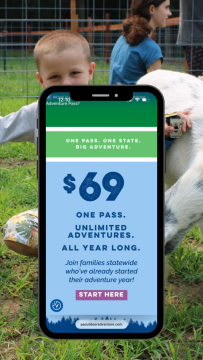
One payment unlocks skiing, caves, climbing, water sports, farms, nature centers, adventure parks, and more.
Your 4th or 5th grader can try rock climbing once and never go back. Or they can try it, discover they love it, and return to a different climbing facility the next weekend.
They can visit a ski resort in winter, a cave system in spring, and a stand-up paddleboard location in summer.
The pass doesn’t require you to predict what your child will love. It lets them discover it.
What This Looks Like in Practice
A family buys the pass thinking their child will use it for skiing.
The child tries skiing. It’s fine. Not life-changing.
Then they visit an adventure park on a whim. Ropes course. Zip lines. The child is fully engaged for three hours.
That family just discovered something they wouldn’t have known to look for.
That’s not luck. That’s what the exploratory window is for.
The Question Isn’t Whether Your Child Is Outdoorsy
The question is whether you’re giving them enough variety to find out what kind of outdoorsy they are.
Skier or climber. Paddler or caver. Alpine or farm-based. Fast or contemplative.
Your 4th or 5th grader doesn’t know yet. That’s not a problem. That’s the opportunity.
Get your pass and let them figure it out.