
Why Outdoor Play Beats Screen Time for Kids
Your child’s screen time average is 25% of their waking hours. That’s not a guess. That’s data from the American Academy of Pediatrics tracking children under 5.
Meanwhile, time outdoors has dropped to historic lows.
Screens give stimulation. Outdoors gives development.
What Screens Take
The American College of Pediatricians tracks what happens when screen time becomes the default:
Attention gets scattered. Research published in multiple studies shows screen time negatively impacts self-regulation abilities. Kids struggle to stay focused on tasks, lack ability to inhibit automatic responses, decreased working memory.
Academic performance drops. Children with 2+ hours of daily screen time show measurably lower scores across subjects.
Sleep suffers. Blue light exposure reduces melatonin production. Bedtime becomes a battle.
Physical activity disappears. Kids who spend 2+ hours looking at screens have a 42% greater risk of being overweight, according to studies reviewed by CHOC Children’s Hospital.
But here’s the part that matters most for 9-11 year olds: screens aren’t building the neural patterns they need. They’re getting stimulation, not development.
What Outdoors Gives
Researchers studying outdoor play have documented specific cognitive benefits that screens can’t replicate.
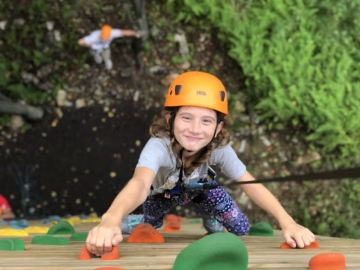
Attention restores. After 60 minutes of unstructured outdoor play, preschool-aged children demonstrated measurably improved attentional control in classroom settings compared to 60 minutes of indoor play.
Focus sharpens. Children with ADHD scored higher on concentration tests after a walk in nature. The effect was measurable and immediate.
Executive function improves. Green outdoor environments promote higher levels of attention and well-being. Kids learn to regulate emotions and implement rules across different play contexts.
Academic performance rises. Students participating in outdoor programs showed a 27% increase in test scores. Not 2% or 5%. Twenty-seven percent.
According to HealthyChildren.org, children who spent more time in nature exploration had improved learning outcomes across the board.
The Neurological Difference
Screens activate reward centers. Dopamine hits. Immediate gratification.
Outdoors activates problem-solving centers. Planning. Decision-making. Adaptation to changing conditions.
Children’s Hospital Los Angeles pediatricians emphasize that kids need “a variety of opportunities for practicing social interactions and self-regulation through a balance of activities.”
Screens narrow sensory experience to two dimensions. Outdoors engages all senses simultaneously: sight, sound, smell, touch, movement.
One builds passive consumption. The other builds active engagement.
Frequently Asked Questions
How much screen time is too much?
The American Academy of Pediatrics recommends no more than 1 hour per day for children ages 2-5, and no more than 2 hours for older children. But quality matters as much as quantity.
Can educational screen time replace outdoor learning?
No. Research shows that even educational media doesn’t provide the same cognitive benefits as real-world outdoor experiences. Kids learn better from live demonstrations than from screens.
What if my child says they’re bored outside?
Boredom is actually beneficial. It’s a gateway to creative problem solving and critical thinking. Give it 15 minutes. Let them figure it out.

Is outdoor time really that different from indoor play?
Yes. Studies comparing indoor versus outdoor play showed children demonstrated better attention and inhibitory control following outdoor play, even when the activities were similar.
How do I get my screen-dependent child interested in outdoor activities?
Start with variety. Try different types of activities. The pass gives access to climbing, paddling, skiing, caves, ziplines. Something will click.
What This Means Practically
Screens aren’t going anywhere. But they shouldn’t be the default.
The PA Outdoor Adventure Pass gives your 4th or 5th grader access to experiences that build different neural pathways. Rock climbing requires problem-solving. Paddling requires attention. Caves spark curiosity. Ski lessons build perseverance.
One year. Multiple experiences. A different relationship with how they spend their time.
Twenty years from now, what matters more: that they mastered another video game level, or that they learned they could do hard things?